How can a platform shift consumer behaviour towards more electronics repair?
Role
Lead Designer
Client
Techniek Nederland
Duration
7 months

Problem space
The need for a new repair experience
3.1%
shrinking of electronics repair industry between 2019 and 2024 and is expected to continue declining in the next 5 years.

Source: IBISWorld Inc., 2024
12 mil.
tons of e-waste are generated annually in Europe.

Source: Eurostat, 2023
38%
of total e-waste is by small equipment, such as vacuum cleaners, constituting the largest global share.
Source: World Economic Forum, 2019
Business Objectives
Creating value across the ecosystem
Redefine
Consumer Repair Journey
Analyze and visualize current user pathways to uncover barriers, drop-off points, and behavioral insights across professional repair scenarios.
Increase
Platform Conversion
Propose new digital interventions for existing national repair platforms that guide users from breakage to professional repair, improving both adoption and retention.
Strengthen
Repair Ecosystem
Bridge knowledge between research institutions, industry, and other stakeholders aligning towards a mutual ecosystem value proposition.


Evaluation & reflection
Platform impact beyond diagnostics
Accessibility
Democratizing Repair Knowledge
"It’s bridging a knowledge gap between me, solving the problem, and the repairer"
— User
User impact
Hyper-Contextual Pathway
"I liked that it adapted to the specific issue I selected, it felt personalized and relevant."
— User
Ecosystem Value
Multi-Stakeholder Potential
“I can also see this being really useful for training new repair staff more effectively.”
— Design Consultant
Reflection
Looking back on the project
I went into this project with a "can-do-everything" instinct, interview everyone, run every workshop technique, chase every thread the research opened up. Warranty law, EU right-to-repair regulation, a 20-organisation coalition, and five separate behavioural models, it would have been easy to disappear into that. What actually shaped the outcome was learning to be selective, and getting comfortable cutting ideas I liked for reasons that had nothing to do with how good they were.
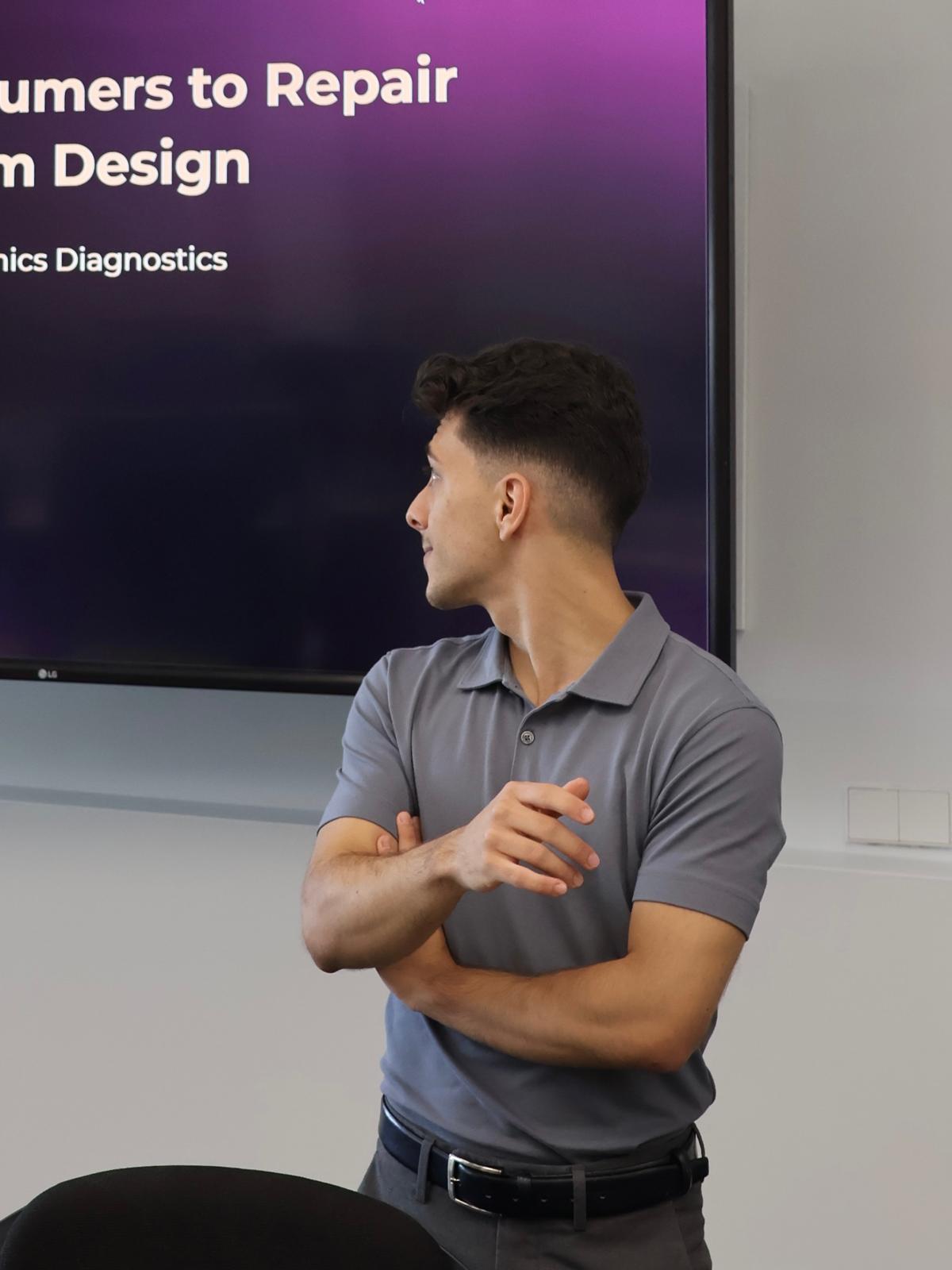
Facilitation taught me the same lesson from a different angle. I came in wanting to run every technique I knew; what worked was structuring my own understanding before inviting stakeholders in, so workshops became spaces to read tensions and dynamics rather than just generate volume.
If there's one line that stuck with me through all of it, it's designing is deciding. Good design isn't keeping every option open, it's making deliberate calls, setting real boundaries, and being able to explain why you didn't go the other way. That's the standard I tried to hold this project to, and it's the one I want to keep holding myself to next.
→
Want to go deeper in process?
This page serves as a short showcase. I can walk you through the full research process, design decisions, and validation in a live session, just reach out.
Request a walkthrough
Other selected work