How can a platform shift consumer behaviour towards more electronics repair?
Role
Lead Designer
Client
Techniek Nederland
Duration
7 months

Want the outcome first?
Click the arrow to jump straight to the solution, or scroll further to explore the reasoning behind it.
Problem space
The need for a new repair experience
3.1%
shrinking of electronics repair industry between 2019 and 2024 and is expected to continue declining in the next 5 years.

Source: IBISWorld Inc., 2024
12 mil.
tons of e-waste are generated annually in Europe.

Source: Eurostat, 2023
38%
of total e-waste is by small equipment, such as vacuum cleaners, constituting the largest global share.
Source: World Economic Forum, 2019
context
Between industry, policy and research institutions
This wasn't a greenfield brief. Techniek Nederland already runs the Nationaal Reparateursregister, a live national repair register that, per the EU's 2027 mandate, every member state must operate. It currently does little beyond listing repairer locations.

The implication
The platform had to be compatible with existing infrastructure, valuable to a multi-stakeholder coalition and aligned with academic research.

Constraint
Warranty repair is a legal case. Out-of-warranty is where the repair-vs-reploce decision is actually a design problem.

Business Objectives
Where the platform aims to create impact

Redefine the Consumer Repair Journey
Analyze and visualize current user pathways to uncover barriers, drop-off points, and behavioral insights across professional repair scenarios.

Increase Platform Conversion
Propose new digital interventions for existing national repair platforms that guide users from breakage to professional repair, improving both adoption and retention.

Strengthen the Repair Ecosystem
Bridge knowledge between research institutions, industry, and other stakeholders aligning towards a mutual ecosystem value proposition.
Deep dive into research
Five-step decision arc
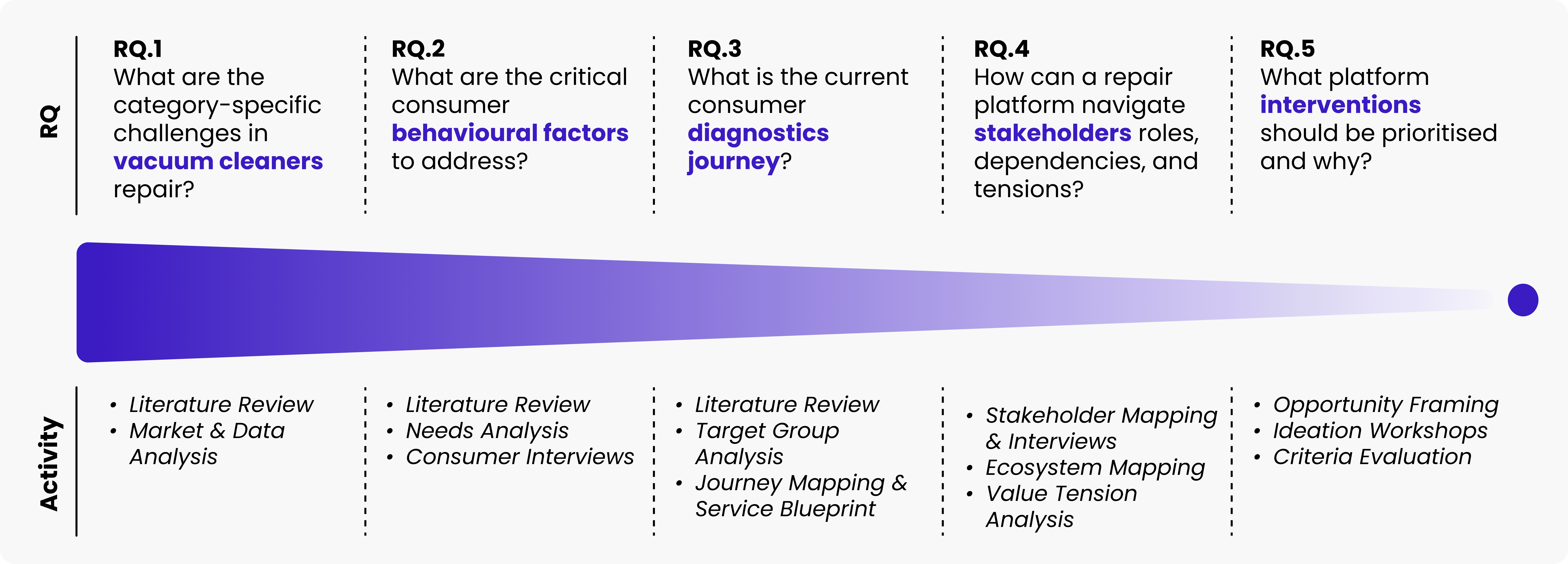
The process followed a five-stage research structure. Each research question addressed a specific layer of the repair ecosystem.
01
Starting Scope
The project needed one product category to ground the platform in something real, rather than abstract. Vacuum cleaners fit: high-volume, moderate lifespan, common failure patterns and carry no social status, so any willingness-to-repair signal is closer to a "pure" behavioural read.
Community repair datasets (Open Repair Alliance, Repair Café, Restarters, 15,000+ logged cases) showed that batteries and motors despite driving up to 92% and 72% of a vacuum's purchase price succeed only 27% and 37% of the time, and end up "beyond repair" in 33–40% of cases.

Design decision
Scope the platform's diagnostic logic around motor and battery failures specifically, the components with the thinnest, most context-dependent margin between "worth repairing" and "beyond repair"
02
Evidence that pushed back
The working assumption going in was that better information would close the gap that if consumers understood repair costs and outcomes clearly, more of them would repair. The literature said otherwise: in a UK study, 77% of EU consumers say they'd rather repair than replace, yet only 18% had actually repaired their current vacuum.
That's not an information gap. It's an attitude-behaviour gap and closing it needed triggers at the moment of decision, not more content in a knowledge base.

Design decision
Reframe the platform's core problem from "inform users better" to "intervene at the moment of failure" before the intention-behaviour gap has a chance to open.
03
What a consumer journey analysis forced me to give up
Drawing on a literature review, field insights, and a stakeholder journey mapping workshop, the as-is consumer journey was structured.
Mapping pain points showed the biggest drop-off wasn't at Decision or Repair, where most platforms focus their effort, but at Pre-Decision to Information Gathering, in the mental-cost weighing that happens right after breakage, before a user has even started looking for help.

Design decision
The platform has to enter at the moment of failure and branch by user knowledge, confidence, and urgency, instead of shipping one linear intake flow.
04
The trade-off I made on purpose
Fifteen stakeholder interviews surfaced five real conflicts of interest in the repair ecosystem: Independent repairers vs. OEM-authorised networks, compliance costs vs. repairer profitability. One stakeholder put it plainly: "Product liability is what the manufacturers are very afraid of, unqualified people doing things in their product with their brand logo on it."
These tensions weren't all solvable in scope. The project explicitly chose not to try to restructure OEM supply chains or lower entry barriers to the national register, both real problems, both out of reach for a 8-month contract project.

Design decision
Position the platform as consumer-facing first, building on the existing authorised-workshop network rather than attempting to fix the supply-chain and access asymmetries underneath it.
05
Convergence, including what got cut
Ideation ran through personal sketching, two brainstorming sessions (designers + six repair-ecosystem stakeholders), and research-derived ideas landing on a wide set of directions. Convergence wasn't a vote. Every idea was checked against scope, platform objectives, design criteria, and design intuition, and a fair number didn't survive:
Dynamic pricing — cut. Commercially attractive, but undermines the platform's core promise of transparency.
AR-guided repair help — cut. Skews toward DIY, not the "Delegate" persona the platform targets.
Verified reviews / visibility ranking — cut. Risked a self-reinforcing bias loop favouring already-visible repairers.
What survived converged on one insight: none of the nine selected interventions works alone, e.g. a cost estimator means nothing without the diagnostic context feeding it.

Design decision
Surface device-specific repair data at the moment of failure to lower perceived barriers.


Evaluation
What the testing surfaced
Ten participants matching the platform's target profile ("Delegate" persona with moderate repair willingness and involvement) walked through the prototype individually in 30–45 minute sessions (platform testing followed by semi-structured interview).
What worked
The step-by-step flow matched people's mental model of troubleshooting calls.
"It doesn't overwhelm you with all the steps but it's one step at a time... this is also usually what they do when you call someone if your wifi is not working."
— Participant 4
What didn't
Transparency and cognitive load pulled against each other. The same detail that built trust also overwhelmed people.
"You also receive a lot of information in the end... it becomes too much information heavy for a simple thing."
— participant 1
What i didn't get to test
The final prototype was a mid-fidelity, desktop-only platform with no live data integration, evaluated with 10 participants recruited by convenience sampling. Real-world adoption at scale, mobile behaviour, and a broader participant pool were left as open questions.
Reflection
Looking back on the project
I went into this project with a "can-do-everything" instinct, interview everyone, run every workshop technique, chase every thread the research opened up. Warranty law, EU right-to-repair regulation, a 20-organisation coalition, and five separate behavioural models, it would have been easy to disappear into that. What actually shaped the outcome was learning to be selective, and getting comfortable cutting ideas I liked for reasons that had nothing to do with how good they were.
Facilitation taught me the same lesson from a different angle. I came in wanting to run every technique I knew; what worked was structuring my own understanding before inviting stakeholders in, so workshops became spaces to read tensions and dynamics rather than just generate volume.
If there's one line that stuck with me through all of it, it's designing is deciding. Good design isn't keeping every option open, it's making deliberate calls, setting real boundaries, and being able to explain why you didn't go the other way. That's the standard I tried to hold this project to, and it's the one I want to keep holding myself to next.